How Polymarket scraping works


Markus_automation
Expert in data parsing and automation
Polymarket is one of the largest prediction markets online, where people bet on the outcomes of real-world events. These can include election results, sports competitions, and more. Position prices change in real time depending on participants' expectations and incoming data. For automation, this creates an interesting technical challenge: the system needs to obtain market data quickly, monitor changes on the blockchain, and respond with minimal latency.
A simple bot that periodically polls the platform's API performs poorly in such scenarios. Some data is available through traditional Web2 interfaces, while critical changes occur directly on the Polygon network. In addition, you have to account for rate limits, indexing delays, unstable RPC connections, and the need to scale the infrastructure.
In this article, we'll look at the components of a reliable Polymarket bot, why relying only on API is not enough, and what problems arise when scaling such infrastructure.
Contents
Stay anonymous, take advantage of multi-accounting, and achieve your goals with the highest-quality anti-detect browser on the market.
Would you like to try Octo Browser at discount?
Use the promo code OCTOSCRAPER to get 30% off any subscription. This offer is valid only for new users.
Why automate the prediction market
Polymarket's mechanics are simple: a user predicts the outcome of an event and buys the corresponding position. If the prediction comes true, the position generates a profit; otherwise, the user loses the invested funds.
A typical participant makes decisions based on their own expectations and analysis of the event. A professional approach is not to guess the outcome, but to identify market inefficiencies and react to them faster than others.
The main automation scenarios are:
Cross-platform arbitrage. The bot looks for price discrepancies between Polymarket, betting platforms, and other markets. If the difference allows opposite positions to be opened simultaneously, the spread can be locked in regardless of the event's final outcome.
News trading. The bot obtains information from external sources or monitors blockchain transactions and reacts faster than the market can adjust the price.
Market making and hedging. The bot simultaneously places buy and sell orders, earning from the spread. Hedging makes it possible to automatically reduce risk in related markets, for example, by offsetting an excessively large Yes position with the opposite one.
There is one common criterion for all three scenarios: the speed of data acquisition directly affects the result.
Why you need a hybrid approach
For tasks like these, a simple script that periodically polls the Polymarket API is not enough. The architecture must work with two data sources simultaneously: traditional Web2 APIs and the blockchain.
Basic architecture: hybrid data collection
A practical approach is to divide the data into two streams:
Static data via REST API. This includes market metadata: names, descriptions, resolution conditions, categories, and other parameters that change relatively infrequently. It is convenient to retrieve such data through the Polymarket API using standard GET requests.
Dynamic data from Polygon. This is the market state: new transactions, liquidity changes, bids, and other events. If the strategy depends on minimal latency, waiting for the frontend to update is inefficient—it is better to obtain the data directly from the blockchain.
Such separation reduces the load on external APIs and prevents resources from being wasted on repeatedly requesting unchanged data.
Technically, this task can be handled through a system of asynchronous queues and process isolation. Regardless of the programming language and server stack you choose, a reliable pattern is to distribute these tasks across independent background workers. One isolated process updates static data through the API, while another monitors blockchain events.
This prevents network operations from blocking the application's main logic, and a failure in one component does not bring down the entire system.
Working with Polygon data in real time
Now that we've covered the data streams’ architecture, let's look at how the bot obtains dynamic data.
On the familiar Web2 Internet, everything is simple: you send a request to a server and receive a structured response in JSON format. In Web3, the process is different. Your bot connects to a special gateway (an RPC node), which forwards the call to the network's smart contract. As a result, the application receives smart contract data and events, which you must then decode and convert into a structure suitable for business logic.
The closer the bot is to the data source, the fewer intermediate links there are between the event and the algorithm. Instead of waiting for the web interface to update, you can monitor smart contract events directly on the network.
In simplified form, the sequence looks like this:
a user performs an action;
the transaction enters the network;
it is included in a block;
the contract state changes;
indexers and the platform's server infrastructure update their data;
the information appears in the interface.
Blockchain monitoring makes it possible to work with data at an earlier stage of this sequence.
WebSocket and ABI: how to receive and decode events
Constantly polling the blockchain is inefficient. Therefore, the bot establishes a WebSocket subscription and receives new events as they appear. The blockchain continuously streams the logs of all new transactions to you.
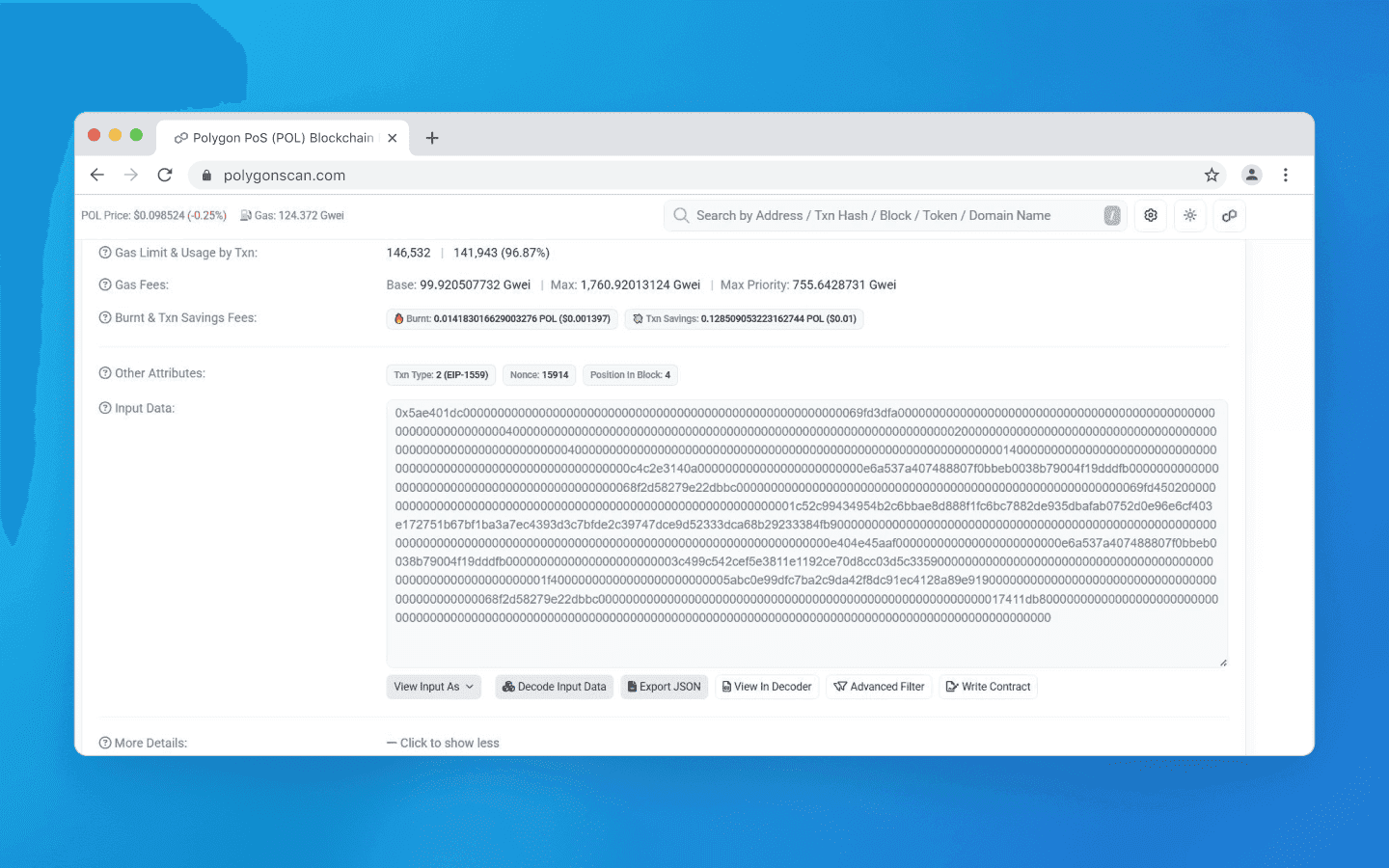
This is what raw event logs on the Polygon network look like before ABI is applied
Raw blockchain data is of limited use for business logic because it is encoded. To convert it into meaningful values, ABI (Application Binary Interface) is used—a description of the smart contract interface that allows the application to understand the structure of its functions and events.
Three important considerations to take into account:
Time between blocks. New Polygon blocks appear regularly, so the bot must receive, process, and pass events to the business logic before the next data block arrives. The greater the delay at each stage, the higher the risk of reacting to a market state that has already changed.
Different data update speeds. The blockchain, Polymarket API, and web interface do not necessarily see changes at the same time. The contract state may change before the API data and/or platform interface are updated. If the strategy is latency-sensitive, relying only on API data is not enough.
WebSocket connection drops. A WSS connection can fail because of RPC provider limitations, network issues, or temporary endpoint unavailability. Therefore, the handler should automatically restore the connection. After reconnecting, it is necessary to identify the last processed block and check whether any new events appeared during the outage.
If the bot simply continues monitoring new events after reconnecting, it may miss some transactions that occurred during the interruption. Therefore, the recovery mechanism must include checking the range of missed blocks and reprocessing the events.
Rate limits and infrastructure management
Any external resource limits the number of requests a client can send within a given period. This applies to both Polymarket and Polygon RPC providers.
Exponential backoff and retries help handle temporary errors, but this is not enough when scaling. You need to account for the limitations of each individual system layer.
Web3 layer: reading the blockchain (Polygon RPC)
Here, the limits are set not by Polymarket, but by the infrastructure provider (node) through which the bot connects to Polygon.
Limits may be expressed in RPS (Requests Per Second), compute units, or other metrics specific to the provider. Three infrastructure levels can be distinguished:
Free nodes: popular services such as Alchemy, GetBlock, and QuickNode cap free tiers at 15–30 RPS. This is definitely insufficient for serious real-time scraping, and these nodes also tend to terminate WebSocket connections without warning.
Basic paid tiers (~$50/month): provide 100–300 RPS. This is generally enough to maintain a stable WSS channel and process new blocks without missing events.
Advanced tiers (from $200/month): provide 500–1,500+ RPS, which is necessary for aggressive historical data scanning and in-depth smart contract analysis.
Web2 layer: collecting metadata (Gamma API)
These are standard REST requests to the public endpoint gamma-api.polymarket.com, where you retrieve static data (market names, tags, descriptions). The API is open, no keys are required, and there are no official limits in the documentation.
However, the entire frontend and Gamma API are protected by Cloudflare's powerful anti-DDoS protection. Scraping from a single IP address provides stable performance at only 10–20 requests per second. Exceeding this threshold triggers a 429 error or CAPTCHA. Therefore, parallel data collection additionally requires a pool of high-quality rotating proxies.
Trading layer
A separate layer is the Central Limit Order Book (CLOB), through which trading operations are performed: placing and canceling orders, and retrieving order book data. API keys and cryptographic signatures are used here.
The platform strictly limits data-reading requests. The limits on trading itself (especially for market makers) are much more liberal:
Order placement: up to 3,500 requests per account every 10 seconds (i.e. 350 RPS).
Order cancellation: up to 3,000 requests every 10 seconds.
If the bot can place an order quickly but receives market information too slowly, the advantage of high trading throughput is largely lost.
Which is better: your own node or SaaS
There are two approaches to overcoming the limit ceiling of the first layer.
1. A local Polygon node. You can rent a server with fast NVMe drives and sufficient CPU and RAM resources and maintain the node infrastructure yourself.
Advantages:
full control over the infrastructure;
no SaaS provider plan limits;
minimal network distance between the bot and your own node.
Disadvantages:
high infrastructure costs;
the need to maintain and update the node yourself;
the risk of desynchronization and the need to monitor the network state.
2. SaaS RPC + load balancing. Instead of running your own node, you can use several commercial RPC providers and distribute the load between them.
For example, requests can be routed through a load balancer: if one endpoint approaches its limit or stops responding, the system switches to another.
For most projects, this approach is easier to operate and allows the infrastructure to be scaled gradually.
Request management
Keep in mind that even a large pool of RPC endpoints cannot save an inefficient architecture.
If the data has not changed, there is no point in requesting it from the blockchain again.
Metadata and historical context should be stored in a local database or fast cache. The external RPC node should primarily be used to retrieve genuinely new data.
This reduces load, lowers latency, and decreases infrastructure costs.
Scaling and the specifics of multi-accounting
When working with multiple accounts, it is important to keep them completely isolated. Polymarket's protection systems should see your bots as hundreds of independent users from different locations around the world, rather than a single server rack in a data center. Let's look at the tools you'll need.
Choosing proxies
For scraping Polymarket, it is not necessary to use expensive residential or mobile proxies. Under high load, datacenter proxies are often a more practical option, especially when the task involves continuous data collection and bot operation.
Speed and stability. Datacenter IPs usually provide lower latency and a more stable connection. For bots that constantly request market, order book, and trade data, this is more important than the origin of the IP itself.
Performance. With properly configured infrastructure, datacenter proxies can maintain a large number of parallel connections and process a significant volume of requests without speed degradation. Proxies can also be combined with other anti-detection mechanisms, such as configuring browser fingerprints and network parameters.
Scaling costs. With continuous scraping, traffic volume grows quickly. Datacenter proxies are generally more cost-effective for such scenarios because their price is not tied to the amount of transferred data. This is especially noticeable when operating dozens or hundreds of threads simultaneously.
Anti-detect browsers
Proxy rotation alone is still not enough when you are accessing a protected API. Modern anti-fraud systems analyze the connecting client's digital fingerprint.
To bypass this protection measure, anti-detect browsers are integrated into the architecture—in our case, Octo Browser. However, in the context of bots, this does not mean manually launching profiles. The system is built around controlling headless anti-detect browser instances through Puppeteer or Playwright.
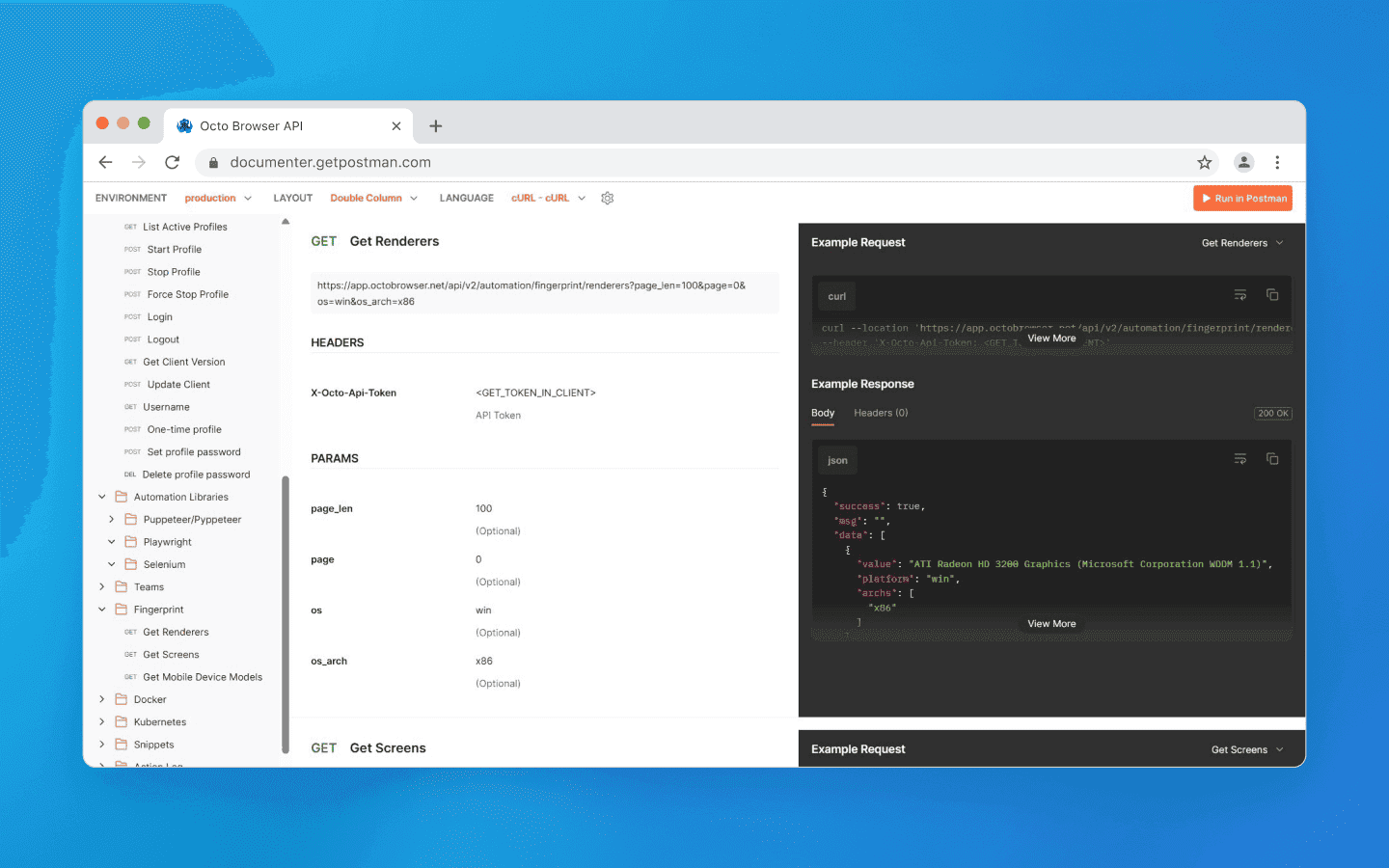
Detailed documentation for the Octo Browser API is available
There is no point in simply changing the user agent or screen resolution. Any advanced protection, such as Cloudflare, can easily expose such scripts by analyzing the call stack or detecting mismatched hardware parameters. Therefore, for automation where browser session isolation is required, it makes more sense to use fully-fledged anti-detect browser profiles rather than a collection of separate spoofing scripts.
A modern browser fingerprint consists of multiple parameters, including OS characteristics, WebGL/WebGPU parameters, fonts, WebRTC, and many other environment properties. The bot connects to such a profile via API, obtains the required session tokens and cookies, and then passes them to lightweight workers for fast interaction with the Gamma API, providing perfect spoofing. Octo Browser allows you to do all of this.

Wallet isolation and protection against Sybil attacks
Scaling a farm requires not only network-level, but also financial isolation. Each bot instance should have its own unique wallet that is not connected to the others.
Local signing: never transmit private keys or sensitive data over the network. Your algorithm should sign transactions locally, sending only encrypted packets to the RPC node. This is a standard security practice: the node receives the command to execute, but has no access to manage the wallet.
Breaking the links: the most common mistake is transferring funds between your own wallets. Any overlap in balances immediately links your accounts into a single network, which can lead to bans.
CEX method: use centralized exchanges to fund the farm and withdraw profits. The exchange provides funds from its hot wallets, making it impossible to trace the links between your bots through a blockchain explorer.
Conclusion
Building a reliable system for scraping Polymarket is not a one-off project, but a process of constant adaptation. The prediction market is extremely dynamic: today you optimize blockchain requests, tomorrow you update the scraping logic because of changes to contract ABIs, and the day after that you look for new ways to bypass Cloudflare protection measures.
The viability of your bot is determined by three factors:
Hybrid architecture: the ability to effectively combine Web2 and Web3 data.
Resilience: infrastructure prepared for RPC node failures and API limits.
Discipline: strict isolation of accounts and wallets.
Only at the intersection of a deep understanding of Polygon's architecture and classic web development methods can tools emerge that deliver results in an environment of intense algorithmic competition.
A sound architecture begins not with choosing a programming language, but with understanding how the network handles failures. Build node rotation into the system design from the very beginning.
Stay anonymous, take advantage of multi-accounting, and achieve your goals with the highest-quality anti-detect browser on the market.
Would you like to try Octo Browser at discount?
Use the promo code OCTOSCRAPER to get 30% off any subscription. This offer is valid only for new users.
Why automate the prediction market
Polymarket's mechanics are simple: a user predicts the outcome of an event and buys the corresponding position. If the prediction comes true, the position generates a profit; otherwise, the user loses the invested funds.
A typical participant makes decisions based on their own expectations and analysis of the event. A professional approach is not to guess the outcome, but to identify market inefficiencies and react to them faster than others.
The main automation scenarios are:
Cross-platform arbitrage. The bot looks for price discrepancies between Polymarket, betting platforms, and other markets. If the difference allows opposite positions to be opened simultaneously, the spread can be locked in regardless of the event's final outcome.
News trading. The bot obtains information from external sources or monitors blockchain transactions and reacts faster than the market can adjust the price.
Market making and hedging. The bot simultaneously places buy and sell orders, earning from the spread. Hedging makes it possible to automatically reduce risk in related markets, for example, by offsetting an excessively large Yes position with the opposite one.
There is one common criterion for all three scenarios: the speed of data acquisition directly affects the result.
Why you need a hybrid approach
For tasks like these, a simple script that periodically polls the Polymarket API is not enough. The architecture must work with two data sources simultaneously: traditional Web2 APIs and the blockchain.
Basic architecture: hybrid data collection
A practical approach is to divide the data into two streams:
Static data via REST API. This includes market metadata: names, descriptions, resolution conditions, categories, and other parameters that change relatively infrequently. It is convenient to retrieve such data through the Polymarket API using standard GET requests.
Dynamic data from Polygon. This is the market state: new transactions, liquidity changes, bids, and other events. If the strategy depends on minimal latency, waiting for the frontend to update is inefficient—it is better to obtain the data directly from the blockchain.
Such separation reduces the load on external APIs and prevents resources from being wasted on repeatedly requesting unchanged data.
Technically, this task can be handled through a system of asynchronous queues and process isolation. Regardless of the programming language and server stack you choose, a reliable pattern is to distribute these tasks across independent background workers. One isolated process updates static data through the API, while another monitors blockchain events.
This prevents network operations from blocking the application's main logic, and a failure in one component does not bring down the entire system.
Working with Polygon data in real time
Now that we've covered the data streams’ architecture, let's look at how the bot obtains dynamic data.
On the familiar Web2 Internet, everything is simple: you send a request to a server and receive a structured response in JSON format. In Web3, the process is different. Your bot connects to a special gateway (an RPC node), which forwards the call to the network's smart contract. As a result, the application receives smart contract data and events, which you must then decode and convert into a structure suitable for business logic.
The closer the bot is to the data source, the fewer intermediate links there are between the event and the algorithm. Instead of waiting for the web interface to update, you can monitor smart contract events directly on the network.
In simplified form, the sequence looks like this:
a user performs an action;
the transaction enters the network;
it is included in a block;
the contract state changes;
indexers and the platform's server infrastructure update their data;
the information appears in the interface.
Blockchain monitoring makes it possible to work with data at an earlier stage of this sequence.
WebSocket and ABI: how to receive and decode events
Constantly polling the blockchain is inefficient. Therefore, the bot establishes a WebSocket subscription and receives new events as they appear. The blockchain continuously streams the logs of all new transactions to you.
This is what raw event logs on the Polygon network look like before ABI is applied
Raw blockchain data is of limited use for business logic because it is encoded. To convert it into meaningful values, ABI (Application Binary Interface) is used—a description of the smart contract interface that allows the application to understand the structure of its functions and events.
Three important considerations to take into account:
Time between blocks. New Polygon blocks appear regularly, so the bot must receive, process, and pass events to the business logic before the next data block arrives. The greater the delay at each stage, the higher the risk of reacting to a market state that has already changed.
Different data update speeds. The blockchain, Polymarket API, and web interface do not necessarily see changes at the same time. The contract state may change before the API data and/or platform interface are updated. If the strategy is latency-sensitive, relying only on API data is not enough.
WebSocket connection drops. A WSS connection can fail because of RPC provider limitations, network issues, or temporary endpoint unavailability. Therefore, the handler should automatically restore the connection. After reconnecting, it is necessary to identify the last processed block and check whether any new events appeared during the outage.
If the bot simply continues monitoring new events after reconnecting, it may miss some transactions that occurred during the interruption. Therefore, the recovery mechanism must include checking the range of missed blocks and reprocessing the events.
Rate limits and infrastructure management
Any external resource limits the number of requests a client can send within a given period. This applies to both Polymarket and Polygon RPC providers.
Exponential backoff and retries help handle temporary errors, but this is not enough when scaling. You need to account for the limitations of each individual system layer.
Web3 layer: reading the blockchain (Polygon RPC)
Here, the limits are set not by Polymarket, but by the infrastructure provider (node) through which the bot connects to Polygon.
Limits may be expressed in RPS (Requests Per Second), compute units, or other metrics specific to the provider. Three infrastructure levels can be distinguished:
Free nodes: popular services such as Alchemy, GetBlock, and QuickNode cap free tiers at 15–30 RPS. This is definitely insufficient for serious real-time scraping, and these nodes also tend to terminate WebSocket connections without warning.
Basic paid tiers (~$50/month): provide 100–300 RPS. This is generally enough to maintain a stable WSS channel and process new blocks without missing events.
Advanced tiers (from $200/month): provide 500–1,500+ RPS, which is necessary for aggressive historical data scanning and in-depth smart contract analysis.
Web2 layer: collecting metadata (Gamma API)
These are standard REST requests to the public endpoint gamma-api.polymarket.com, where you retrieve static data (market names, tags, descriptions). The API is open, no keys are required, and there are no official limits in the documentation.
However, the entire frontend and Gamma API are protected by Cloudflare's powerful anti-DDoS protection. Scraping from a single IP address provides stable performance at only 10–20 requests per second. Exceeding this threshold triggers a 429 error or CAPTCHA. Therefore, parallel data collection additionally requires a pool of high-quality rotating proxies.
Trading layer
A separate layer is the Central Limit Order Book (CLOB), through which trading operations are performed: placing and canceling orders, and retrieving order book data. API keys and cryptographic signatures are used here.
The platform strictly limits data-reading requests. The limits on trading itself (especially for market makers) are much more liberal:
Order placement: up to 3,500 requests per account every 10 seconds (i.e. 350 RPS).
Order cancellation: up to 3,000 requests every 10 seconds.
If the bot can place an order quickly but receives market information too slowly, the advantage of high trading throughput is largely lost.
Which is better: your own node or SaaS
There are two approaches to overcoming the limit ceiling of the first layer.
1. A local Polygon node. You can rent a server with fast NVMe drives and sufficient CPU and RAM resources and maintain the node infrastructure yourself.
Advantages:
full control over the infrastructure;
no SaaS provider plan limits;
minimal network distance between the bot and your own node.
Disadvantages:
high infrastructure costs;
the need to maintain and update the node yourself;
the risk of desynchronization and the need to monitor the network state.
2. SaaS RPC + load balancing. Instead of running your own node, you can use several commercial RPC providers and distribute the load between them.
For example, requests can be routed through a load balancer: if one endpoint approaches its limit or stops responding, the system switches to another.
For most projects, this approach is easier to operate and allows the infrastructure to be scaled gradually.
Request management
Keep in mind that even a large pool of RPC endpoints cannot save an inefficient architecture.
If the data has not changed, there is no point in requesting it from the blockchain again.
Metadata and historical context should be stored in a local database or fast cache. The external RPC node should primarily be used to retrieve genuinely new data.
This reduces load, lowers latency, and decreases infrastructure costs.
Scaling and the specifics of multi-accounting
When working with multiple accounts, it is important to keep them completely isolated. Polymarket's protection systems should see your bots as hundreds of independent users from different locations around the world, rather than a single server rack in a data center. Let's look at the tools you'll need.
Choosing proxies
For scraping Polymarket, it is not necessary to use expensive residential or mobile proxies. Under high load, datacenter proxies are often a more practical option, especially when the task involves continuous data collection and bot operation.
Speed and stability. Datacenter IPs usually provide lower latency and a more stable connection. For bots that constantly request market, order book, and trade data, this is more important than the origin of the IP itself.
Performance. With properly configured infrastructure, datacenter proxies can maintain a large number of parallel connections and process a significant volume of requests without speed degradation. Proxies can also be combined with other anti-detection mechanisms, such as configuring browser fingerprints and network parameters.
Scaling costs. With continuous scraping, traffic volume grows quickly. Datacenter proxies are generally more cost-effective for such scenarios because their price is not tied to the amount of transferred data. This is especially noticeable when operating dozens or hundreds of threads simultaneously.
Anti-detect browsers
Proxy rotation alone is still not enough when you are accessing a protected API. Modern anti-fraud systems analyze the connecting client's digital fingerprint.
To bypass this protection measure, anti-detect browsers are integrated into the architecture—in our case, Octo Browser. However, in the context of bots, this does not mean manually launching profiles. The system is built around controlling headless anti-detect browser instances through Puppeteer or Playwright.
Detailed documentation for the Octo Browser API is available
There is no point in simply changing the user agent or screen resolution. Any advanced protection, such as Cloudflare, can easily expose such scripts by analyzing the call stack or detecting mismatched hardware parameters. Therefore, for automation where browser session isolation is required, it makes more sense to use fully-fledged anti-detect browser profiles rather than a collection of separate spoofing scripts.
A modern browser fingerprint consists of multiple parameters, including OS characteristics, WebGL/WebGPU parameters, fonts, WebRTC, and many other environment properties. The bot connects to such a profile via API, obtains the required session tokens and cookies, and then passes them to lightweight workers for fast interaction with the Gamma API, providing perfect spoofing. Octo Browser allows you to do all of this.
Wallet isolation and protection against Sybil attacks
Scaling a farm requires not only network-level, but also financial isolation. Each bot instance should have its own unique wallet that is not connected to the others.
Local signing: never transmit private keys or sensitive data over the network. Your algorithm should sign transactions locally, sending only encrypted packets to the RPC node. This is a standard security practice: the node receives the command to execute, but has no access to manage the wallet.
Breaking the links: the most common mistake is transferring funds between your own wallets. Any overlap in balances immediately links your accounts into a single network, which can lead to bans.
CEX method: use centralized exchanges to fund the farm and withdraw profits. The exchange provides funds from its hot wallets, making it impossible to trace the links between your bots through a blockchain explorer.
Conclusion
Building a reliable system for scraping Polymarket is not a one-off project, but a process of constant adaptation. The prediction market is extremely dynamic: today you optimize blockchain requests, tomorrow you update the scraping logic because of changes to contract ABIs, and the day after that you look for new ways to bypass Cloudflare protection measures.
The viability of your bot is determined by three factors:
Hybrid architecture: the ability to effectively combine Web2 and Web3 data.
Resilience: infrastructure prepared for RPC node failures and API limits.
Discipline: strict isolation of accounts and wallets.
Only at the intersection of a deep understanding of Polygon's architecture and classic web development methods can tools emerge that deliver results in an environment of intense algorithmic competition.
A sound architecture begins not with choosing a programming language, but with understanding how the network handles failures. Build node rotation into the system design from the very beginning.
Stay up to date with the latest Octo Browser news
By clicking the button you agree to our Privacy Policy.
Stay up to date with the latest Octo Browser news
By clicking the button you agree to our Privacy Policy.
Stay up to date with the latest Octo Browser news
By clicking the button you agree to our Privacy Policy.

Join Octo Browser now
Or contact Customer Service at any time with any questions you might have.
Join Octo Browser now
Or contact Customer Service at any time with any questions you might have.
Join Octo Browser now
Or contact Customer Service at any time with any questions you might have.