How to use multi-accounting to test your advertising ideas

ProxyWing
Article from proxy provider ProxyWing
Imagine you have the ability to see Internet resources through the eyes of any user. You control digital fingerprint settings, create configurations for any device, use proxies to test language-specific and regional hypotheses, and generate the necessary history stored in cookies.
Multi-accounting is not just a way to bypass platform restrictions. It is a flexible tool for testing ad hypotheses, optimizing advertising campaigns, and scaling businesses. Together with the ProxyWing team, we explore how to properly use multiple accounts to test various advertising ideas.
Contents
Maintain your online anonymity with Octo Browser. Your real digital fingerprint cannot be tracked.
Would you like to try Octo Browser at discount?
Use the promo code OCTOAFFILIATE to get 30% off any subscription. This offer is valid only for new users.
Why multi-accounting is necessary for testing
In targeted advertising, multi-accounting allows you to test different creatives simultaneously on Meta, TikTok, and Google Ads.
Technical foundations of multi-accounting
Digital fingerprint: the parameters that websites track
When logging into an account, websites don’t only look at the IP address. Each device transmits various technical parameters by which platforms identify users. The combination of this data is called a browser fingerprint.
Parameters tracked by platforms include:
IP address and geolocation.
User agent: data about the browser and operating system.
Canvas: how the GPU renders images.
WebGL: characteristics of the GPU and its drivers.
System fonts: a set of fonts unique to each OS.
Audio context: features of sound processing.
Screen resolution and color depth.
Time zone and system language.
Cookies, local storage, plugins.
Platforms like Meta, Google Ads, or Amazon analyze this data. If you log into different accounts from the same device, these systems detect matching fingerprints. They link such accounts together and may block them as suspicious.
How anti-detect browsers work
Anti-detect browsers isolate the parameters of your actual device and allow you to create and configure digital fingerprints for multiple virtual profiles. In Octo Browser, this is implemented as follows:
Spoofing of technical parameters. The digital fingerprint is spoofed at the browser kernel level and includes more than 50 parameters: Canvas, WebGL, system fonts, audio context, and others.
Imitation of real devices. Each profile is perceived by platforms as a separate user with their own PC or laptop.
Full session isolation. Data between accounts does not overlap: cookies, history, and cache remain separate.
Spoofing geolocation and IP address through integration with proxy services. All parameters (time zone, language, geolocation) are synchronized with the selected IP.
The latest Chromium kernel. This reduces the risk of bans, as outdated browser versions are easier for anti-fraud systems to detect.
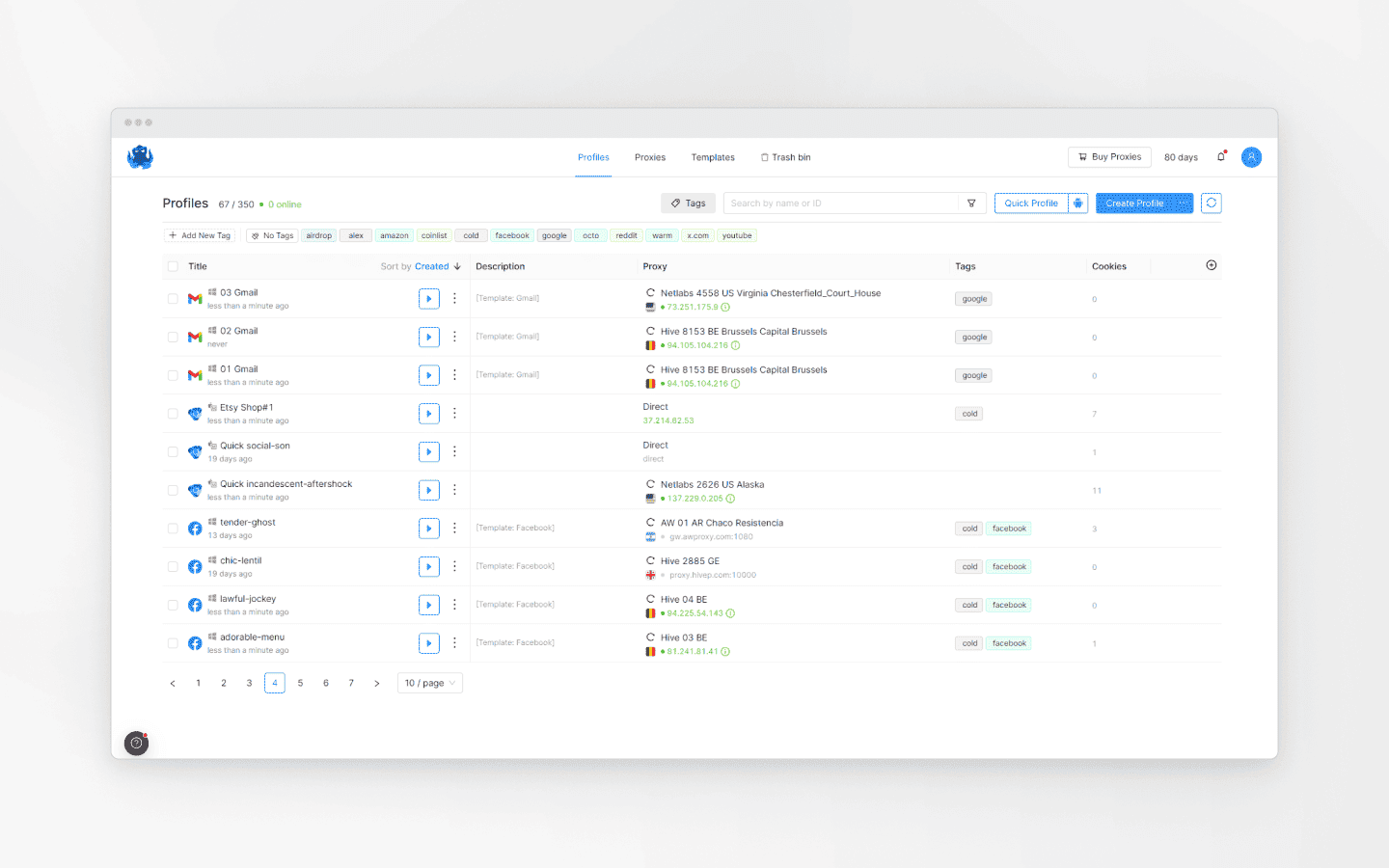
Without an anti-detect browser, it is safe to manage only 2–3 accounts from one device. With Octo Browser, the number of profiles is limited only by your computer’s capacity.
Run as many advertising campaigns as you want. Octo Browser prevents blocks, helps you test offers, and increases your revenue.
Anti-detect browsers: key features
Anti-detect browsers differ significantly in the quality of fingerprint parameter spoofing, performance, usability, and available features. When choosing, pay attention to the following criteria:
Fingerprint quality. A top-quality anti-detect browser should spoof more than 50 parameters. Check how well your anti-detect browser spoofs the fingerprint using services like Whoer.net, Pixelscan, or BrowserLeaks.
Proxy integration. Your browser should support all popular protocols and proxy types.
Easy profile management. The ability to quickly create, copy, and configure profiles. For teams, profile synchronization in the cloud storage is important.
Automation. API support for automating routine operations: profile creation, data updates, bulk actions. Ideally, the API allows you to perform all actions available via the interface and provides detailed documentation and ready-made scripts.
Support for different operating systems. Your anti-detect browser should work on Windows, macOS, and Linux.
Which proxies to choose for multi-accounting
Proxies are a mandatory tool for changing IP addresses and geolocation. The type of proxy affects the level of trust platforms assign to an account. Your proxy choice depends on your tasks.
Residential (ISP).
IP addresses issued by Internet providers to regular users. Platforms consider them “clean.” Suitable for account registration and long-term work.Mobile (4G/5G).
IP addresses of mobile operators. One of the most reliable options, used for working with traffic-sensitive platforms.Datacenter proxies.
Affordable, but more likely to raise suspicion, as the IPs belong to data centers. Suitable for certain data collection tasks: scraping, monitoring, and preliminary tests.
What to consider when choosing proxies
The IP address must match the geolocation specified in the profile settings.
Proxies should not be blacklisted or already banned on the platform.
It is better to use dedicated IPs rather than shared proxies.
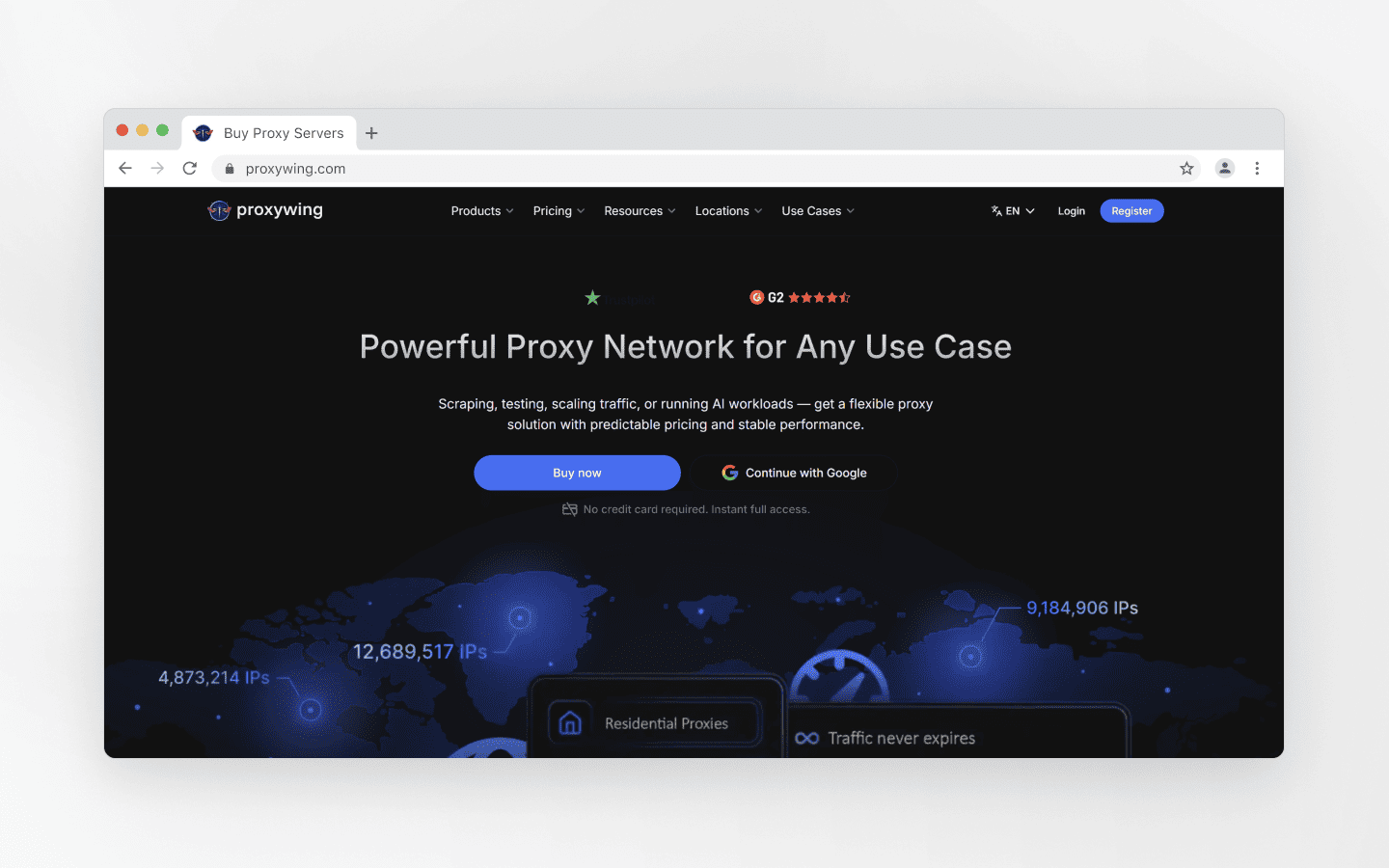
For this article, we used universal proxy solutions from ProxyWing, which are suitable for various tasks and have a number of advantages: high speed (1 Gbps), unlimited traffic, and 99% uptime.
Testing ideas in targeted advertising
How do you understand that an advertising campaign truly reaches the target audience rather than wasting budget due to targeting errors?
An anti-detect browser allows you to divide accounts into different groups that are not connected to each other. Advertising platforms treat each virtual profile as a separate user. This opens up broad opportunities for testing.
Simply launch a profile in Octo Browser and generate the necessary history of search queries and website visits. This gives you a ready-made model for analyzing the advertising environment and competitors’ creatives.
Audience isolation. Audiences do not overlap, and data for each group remains independent.
Budget optimization. Splitting tests across accounts helps identify the most effective strategies and redirect funds to them.
Flexible scaling. Add accounts as your budget grows instead of pushing one account to platform limits.
Bypassing geo-restrictions. Test ads or content in different regions using local IPs and settings.
Advantages for testing
A/B testing of creatives
Create multiple accounts on one platform.
In each account, launch different creatives (videos, images, texts) for the same audience.
Compare CTR, conversions, and cost per lead.
Audience testing
Segregate accounts by target audiences (age, interests, geo).
Identify which group performs best and scale campaigns accordingly.
Geographical segmentation
Assign a separate account to each region or language segment.
Check time settings, language, and whether proxy geolocation matches the target market.
Experiments without risk
Test aggressive creatives or new niches without risking accounts with predictable revenue.
Testing new platforms
Use separate accounts to test your ads on TikTok, Snapchat, or Google Ads.
This helps determine which platform delivers the best ROI without risking the main account.
Risk management
If one account is blocked or restricted, use other accounts to continue working.
Advertising platforms, such as Met, Google, TikTok, set daily limits and strictly enforce their rules. Without an anti-detect browser, you will not be able to run large-scale advertising campaigns. To bypass ad platform restrictions, use an anti-detect browser combined with residential or mobile proxies.
Best multi-accounting practices
Isolate digital fingerprints
Platforms detect links between accounts through identical digital fingerprints. Use anti-detect browsers that prevent data leaks at the device level.
Use proxies for each account
One IP address for multiple accounts is a clear red flag for anti-fraud systems. To avoid mass bans, assign a separate proxy to each profile.
Simulate natural user behavior
Anti-fraud systems are sensitive to patterned actions. Simulate natural behavior, take pauses between actions, vary activity times, and avoid simultaneous actions across all profiles.
Separate accounts by tasks
Use different accounts for testing ad ideas and scaling active campaigns. Clear separation by ad goals and topics simplifies analytics and reduces risks.
Use unique data for each profile
Platforms link accounts via shared emails, phone numbers, and payment methods. Register each account with unique data: a separate email, phone number, and payment card.
Monitor platform updates
Advertising platforms regularly update their algorithms and requirements. Track policy changes and monitor actions that may trigger platform suspicion. Use legitimate tools for account management: Business Manager for Meta and MCC for Google Ads.
Common mistakes and how to avoid them
Mistake 1. Too many variables in one test
If you change the campaign type, bidding strategy, and creatives at the same time, you won’t understand what influenced the result.
How to avoid: test one parameter at a time.
Mistake 2. Prematurely stopping a test
Positive results in the first week are not a reason to stop testing. Algorithms need time to stabilize.
How to avoid: allocate at least 4–6 weeks for testing.
Mistake 3. Ignoring interaction between campaigns
Testing individual campaigns does not show how they affect each other. Performance Max may steal traffic from Search, while overall account efficiency increases.
How to avoid: use multi-campaign experiments if the platform supports them.
Conclusions
Multi-accounting with Octo Browsers allows you to test various advertising hypotheses, quickly launch successful setups, and protect your business from unpredictable platform decisions. After validating regional, language, and creative hypotheses, you minimize risks when launching new campaigns, optimize budgets by identifying the most effective strategies, and scale successful solutions.
With Octo Browser, you can create an unlimited number of browser profiles indistinguishable from real users and bypass platform restrictions. ProxyWing will help you with this by providing stable proxies for any tasks.
Maintain your online anonymity with Octo Browser. Your real digital fingerprint cannot be tracked.
Would you like to try Octo Browser at discount?
Use the promo code OCTOAFFILIATE to get 30% off any subscription. This offer is valid only for new users.
Why multi-accounting is necessary for testing
In targeted advertising, multi-accounting allows you to test different creatives simultaneously on Meta, TikTok, and Google Ads.
Technical foundations of multi-accounting
Digital fingerprint: the parameters that websites track
When logging into an account, websites don’t only look at the IP address. Each device transmits various technical parameters by which platforms identify users. The combination of this data is called a browser fingerprint.
Parameters tracked by platforms include:
IP address and geolocation.
User agent: data about the browser and operating system.
Canvas: how the GPU renders images.
WebGL: characteristics of the GPU and its drivers.
System fonts: a set of fonts unique to each OS.
Audio context: features of sound processing.
Screen resolution and color depth.
Time zone and system language.
Cookies, local storage, plugins.
Platforms like Meta, Google Ads, or Amazon analyze this data. If you log into different accounts from the same device, these systems detect matching fingerprints. They link such accounts together and may block them as suspicious.
How anti-detect browsers work
Anti-detect browsers isolate the parameters of your actual device and allow you to create and configure digital fingerprints for multiple virtual profiles. In Octo Browser, this is implemented as follows:
Spoofing of technical parameters. The digital fingerprint is spoofed at the browser kernel level and includes more than 50 parameters: Canvas, WebGL, system fonts, audio context, and others.
Imitation of real devices. Each profile is perceived by platforms as a separate user with their own PC or laptop.
Full session isolation. Data between accounts does not overlap: cookies, history, and cache remain separate.
Spoofing geolocation and IP address through integration with proxy services. All parameters (time zone, language, geolocation) are synchronized with the selected IP.
The latest Chromium kernel. This reduces the risk of bans, as outdated browser versions are easier for anti-fraud systems to detect.
Without an anti-detect browser, it is safe to manage only 2–3 accounts from one device. With Octo Browser, the number of profiles is limited only by your computer’s capacity.
Run as many advertising campaigns as you want. Octo Browser prevents blocks, helps you test offers, and increases your revenue.
Anti-detect browsers: key features
Anti-detect browsers differ significantly in the quality of fingerprint parameter spoofing, performance, usability, and available features. When choosing, pay attention to the following criteria:
Fingerprint quality. A top-quality anti-detect browser should spoof more than 50 parameters. Check how well your anti-detect browser spoofs the fingerprint using services like Whoer.net, Pixelscan, or BrowserLeaks.
Proxy integration. Your browser should support all popular protocols and proxy types.
Easy profile management. The ability to quickly create, copy, and configure profiles. For teams, profile synchronization in the cloud storage is important.
Automation. API support for automating routine operations: profile creation, data updates, bulk actions. Ideally, the API allows you to perform all actions available via the interface and provides detailed documentation and ready-made scripts.
Support for different operating systems. Your anti-detect browser should work on Windows, macOS, and Linux.
Which proxies to choose for multi-accounting
Proxies are a mandatory tool for changing IP addresses and geolocation. The type of proxy affects the level of trust platforms assign to an account. Your proxy choice depends on your tasks.
Residential (ISP).
IP addresses issued by Internet providers to regular users. Platforms consider them “clean.” Suitable for account registration and long-term work.Mobile (4G/5G).
IP addresses of mobile operators. One of the most reliable options, used for working with traffic-sensitive platforms.Datacenter proxies.
Affordable, but more likely to raise suspicion, as the IPs belong to data centers. Suitable for certain data collection tasks: scraping, monitoring, and preliminary tests.
What to consider when choosing proxies
The IP address must match the geolocation specified in the profile settings.
Proxies should not be blacklisted or already banned on the platform.
It is better to use dedicated IPs rather than shared proxies.
For this article, we used universal proxy solutions from ProxyWing, which are suitable for various tasks and have a number of advantages: high speed (1 Gbps), unlimited traffic, and 99% uptime.
Testing ideas in targeted advertising
How do you understand that an advertising campaign truly reaches the target audience rather than wasting budget due to targeting errors?
An anti-detect browser allows you to divide accounts into different groups that are not connected to each other. Advertising platforms treat each virtual profile as a separate user. This opens up broad opportunities for testing.
Simply launch a profile in Octo Browser and generate the necessary history of search queries and website visits. This gives you a ready-made model for analyzing the advertising environment and competitors’ creatives.
Audience isolation. Audiences do not overlap, and data for each group remains independent.
Budget optimization. Splitting tests across accounts helps identify the most effective strategies and redirect funds to them.
Flexible scaling. Add accounts as your budget grows instead of pushing one account to platform limits.
Bypassing geo-restrictions. Test ads or content in different regions using local IPs and settings.
Advantages for testing
A/B testing of creatives
Create multiple accounts on one platform.
In each account, launch different creatives (videos, images, texts) for the same audience.
Compare CTR, conversions, and cost per lead.
Audience testing
Segregate accounts by target audiences (age, interests, geo).
Identify which group performs best and scale campaigns accordingly.
Geographical segmentation
Assign a separate account to each region or language segment.
Check time settings, language, and whether proxy geolocation matches the target market.
Experiments without risk
Test aggressive creatives or new niches without risking accounts with predictable revenue.
Testing new platforms
Use separate accounts to test your ads on TikTok, Snapchat, or Google Ads.
This helps determine which platform delivers the best ROI without risking the main account.
Risk management
If one account is blocked or restricted, use other accounts to continue working.
Advertising platforms, such as Met, Google, TikTok, set daily limits and strictly enforce their rules. Without an anti-detect browser, you will not be able to run large-scale advertising campaigns. To bypass ad platform restrictions, use an anti-detect browser combined with residential or mobile proxies.
Best multi-accounting practices
Isolate digital fingerprints
Platforms detect links between accounts through identical digital fingerprints. Use anti-detect browsers that prevent data leaks at the device level.
Use proxies for each account
One IP address for multiple accounts is a clear red flag for anti-fraud systems. To avoid mass bans, assign a separate proxy to each profile.
Simulate natural user behavior
Anti-fraud systems are sensitive to patterned actions. Simulate natural behavior, take pauses between actions, vary activity times, and avoid simultaneous actions across all profiles.
Separate accounts by tasks
Use different accounts for testing ad ideas and scaling active campaigns. Clear separation by ad goals and topics simplifies analytics and reduces risks.
Use unique data for each profile
Platforms link accounts via shared emails, phone numbers, and payment methods. Register each account with unique data: a separate email, phone number, and payment card.
Monitor platform updates
Advertising platforms regularly update their algorithms and requirements. Track policy changes and monitor actions that may trigger platform suspicion. Use legitimate tools for account management: Business Manager for Meta and MCC for Google Ads.
Common mistakes and how to avoid them
Mistake 1. Too many variables in one test
If you change the campaign type, bidding strategy, and creatives at the same time, you won’t understand what influenced the result.
How to avoid: test one parameter at a time.
Mistake 2. Prematurely stopping a test
Positive results in the first week are not a reason to stop testing. Algorithms need time to stabilize.
How to avoid: allocate at least 4–6 weeks for testing.
Mistake 3. Ignoring interaction between campaigns
Testing individual campaigns does not show how they affect each other. Performance Max may steal traffic from Search, while overall account efficiency increases.
How to avoid: use multi-campaign experiments if the platform supports them.
Conclusions
Multi-accounting with Octo Browsers allows you to test various advertising hypotheses, quickly launch successful setups, and protect your business from unpredictable platform decisions. After validating regional, language, and creative hypotheses, you minimize risks when launching new campaigns, optimize budgets by identifying the most effective strategies, and scale successful solutions.
With Octo Browser, you can create an unlimited number of browser profiles indistinguishable from real users and bypass platform restrictions. ProxyWing will help you with this by providing stable proxies for any tasks.
Stay up to date with the latest Octo Browser news
By clicking the button you agree to our Privacy Policy.
Stay up to date with the latest Octo Browser news
By clicking the button you agree to our Privacy Policy.
Stay up to date with the latest Octo Browser news
By clicking the button you agree to our Privacy Policy.

Join Octo Browser now
Or contact Customer Service at any time with any questions you might have.
Join Octo Browser now
Or contact Customer Service at any time with any questions you might have.
Join Octo Browser now
Or contact Customer Service at any time with any questions you might have.